

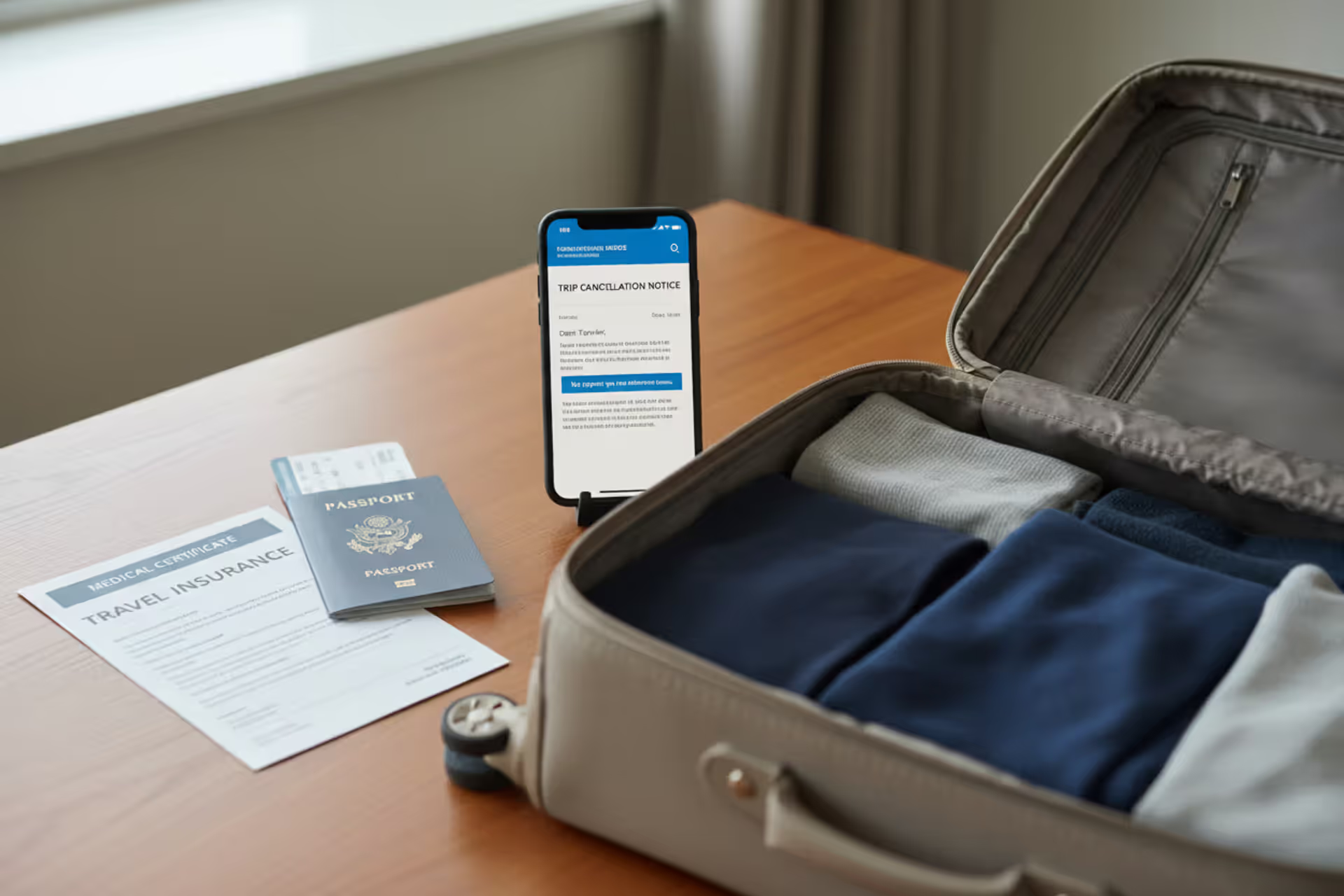
Traveler at airport check-in reviewing travel insurance policy on smartphone
Travel Insurance Coverage Guide for US Travelers

You've just dropped $6,000 on a dream vacation to Greece. Three days before departure, your doctor diagnoses pneumonia and orders bed rest. Without coverage, you're out every penny. With the right policy, you file a claim and recoup most of your costs.
That's the promise of travel insurance, anyway. The catch? Not all policies deliver on that promise equally. Some travelers get reimbursed quickly. Others discover their "comprehensive" plan excludes the exact scenario they're claiming. The difference comes down to understanding coverage details before problems strike.
Most people buy travel insurance the way they agree to software terms—a quick scroll, maybe skimming a few bullet points, then clicking "purchase." Later, when filing a claim, they're shocked to learn their situation doesn't qualify. This guide walks through what these policies actually protect, what they don't, and how to pick coverage that works for your specific trip.
What Travel Insurance Covers
Travel insurance handles four main problems: canceled trips, medical emergencies abroad, lost belongings, and significant delays. Each addresses different financial risks at different stages of your journey.
Trip cancellation reimbursement returns money spent on non-refundable bookings when you can't travel for a qualifying reason. Your policy lists these reasons explicitly—usually things like documented illness requiring a doctor to forbid travel, immediate family member deaths, jury duty summons, or your destination becoming uninhabitable due to natural disasters. Book a $5,500 Alaska cruise six months ahead, then suffer a documented heart attack two weeks before sailing? Your insurer cuts a check for those prepaid costs (minus whatever deductible you chose).
Emergency medical reimbursement covers treatment costs when you get sick or hurt during your trip. This matters enormously outside US borders, where Medicare doesn't follow you and your regular health insurance might refuse coverage or demand upfront payment before treating you. That sprained ankle in Tokyo could run $2,400 at a private clinic. Food poisoning requiring overnight hospitalization in Bali? Easily $3,800. Medical coverage pays these bills directly or reimburses you after you've paid.
Lost or stolen baggage protection compensates you when airlines lose your luggage or thieves take your belongings. Airlines offer their own compensation, typically $50-150 per bag for domestic flights. Travel insurance adds significantly more—usually $1,000-2,500 total—though per-item limits still apply. Your $900 laptop and $600 camera both vanish from checked luggage? The insurer pays up to your policy's limits after the airline's compensation runs out.

Author: Samantha Lowell;
Source: visitmuseumcampussouth.com
Delay coverage reimburses essential expenses when your trip gets postponed for qualifying reasons like weather, mechanical aircraft problems, or other issues outside your control. Stuck overnight in Denver because mechanical issues grounded your connecting flight? This coverage pays for your hotel room, meals, and basic toiletries until you can continue—typically up to $500-1,000 per incident.
These four categories form the backbone of standard comprehensive plans. Insurers bundle them together with different dollar limits and rules, though some let you purchase individual coverage types if you only need specific protection.
Types of Travel Insurance Coverage
Insurance companies slice coverage into distinct categories. Some travelers need all of them. Others need just one or two. Knowing the differences helps you avoid paying for protection you'll never use.
Medical and Emergency Evacuation Coverage
Medical protection pays bills when illness or injury strikes during your trip. Standard plans handle emergency room treatment, hospital admission, prescription drugs, and follow-up appointments for new conditions that develop while you're traveling.
Emergency evacuation moves you to proper medical facilities or back home when local hospitals can't provide adequate care. Get bitten by a venomous snake while hiking in rural Thailand? Medical evacuation by helicopter to Bangkok could hit $75,000. Fall seriously ill on a cruise ship far from shore? Airlift to the nearest hospital capable of advanced treatment can exceed $100,000. This coverage handles those astronomical transport costs.

Author: Samantha Lowell;
Source: visitmuseumcampussouth.com
Policies split these into separate dollar caps. Medical might max out at $75,000 while evacuation extends to $300,000. Someone with diabetes or high blood pressure should push for higher medical limits—say $150,000 minimum. Planning backcountry trekking in remote regions? Prioritize evacuation coverage of at least $500,000.
One more thing evacuation covers: returning deceased travelers' remains to the United States. Nobody wants to think about this, but international death involves complex logistics, paperwork across multiple governments, and substantial costs. Coverage handles these grim details so surviving family members don't have to navigate foreign bureaucracy while grieving.
Trip Cancellation and Interruption Coverage
Cancellation coverage refunds prepaid trip costs when you can't depart as scheduled. Interruption coverage pays for unused portions of your trip plus extra transportation home if you must leave early. Say you've booked three weeks touring Southeast Asia for $9,500, but on day seven your sister suffers a stroke back home. Interruption coverage reimburses the two unused weeks and pays for changing your return flight on short notice—often double or triple the original ticket price.
Here's the critical part: these only pay for situations specifically listed in your policy documents. Standard qualifying scenarios include:
- Documented serious illness or injury preventing travel (yours, a traveling companion's, or immediate family)
- Death of you, your travel partner, or immediate family members
- Natural disasters making your destination officially uninhabitable
- Government-issued mandatory evacuation orders
- Documented jury duty or subpoena requiring your court appearance
- Involuntary job termination (layoffs meeting specific conditions, not quitting or getting fired for cause)
- Your home becoming uninhabitable due to fire, flooding, or vandalism
"Cancel for any reason" riders expand this limited list but come with strings attached. First, you must purchase CFAR within 14-21 days of making your initial trip deposit. Second, it costs 40-60% more than standard coverage. Third, you only get back 50-75% of prepaid costs, not 100%. Fourth, you must cancel at minimum two full days before your scheduled departure.
Baggage and Personal Belongings Coverage
This protects your stuff during travel. Standard policies cover items that get lost by airlines, stolen from hotel rooms or rental cars, damaged during transit, or delayed in reaching you.
Here's how limits work: a typical policy might state "$2,000 maximum baggage coverage with $300 per-item limit." Your checked bag containing a $1,100 laptop, $750 camera, and $500 in clothing gets lost permanently. You'd receive $2,000 minus your deductible—not the full $2,350 value—because the overall policy cap trumps individual item values.
Baggage delay reimbursement kicks in when your luggage arrives substantially late—usually 6-12 hours after you land. Buy necessary basics like underwear, a shirt, pants, toothbrush, and deodorant, keep all receipts, and submit them for reimbursement up to your policy's delay limit (commonly $250-600).
Critical rule: report problems immediately. Lost bag? File the airline's official report before leaving the airport. Items stolen from your hotel? Get a police report that same day. Waiting 48+ hours to document issues frequently disqualifies claims because insurers can't verify the timeline.
What Travel Insurance Does Not Cover
Exclusions often matter more than inclusions. Policies explicitly refuse payment for specific situations, and these denials catch travelers off guard more than any other aspect of travel insurance.
Pre-existing medical conditions top the exclusion list. Received treatment, medication adjustments, or medical advice for any condition in the 60-180 days before buying insurance? That condition is "pre-existing," and complications arising from it typically won't be covered. Your cardiologist tweaked your heart medication three months before your policy purchase date? A heart attack during your trip likely won't be covered—even though you felt fine when you bought insurance. Some insurers waive pre-existing condition exclusions if you purchase within 14-21 days of your initial trip payment, insure your complete trip cost, and meet other specific requirements. These waivers have limitations, though. Read the fine print on exactly what pre-existing conditions get covered and under what circumstances.

Author: Samantha Lowell;
Source: visitmuseumcampussouth.com
Adventure and extreme activities need special riders. Base policies exclude injuries from activities insurers deem high-risk: skydiving, bungee jumping, rock climbing, scuba diving below certain depths (commonly 60 feet), parasailing, or operating motorcycles and ATVs. Planning to cage dive with great whites in South Africa or go heli-skiing in British Columbia? You'll need an adventure sports add-on—and those aren't available for all activities at all destinations.
Known events and circumstances can't be insured retroactively. A hurricane is already tracking toward your Caribbean destination when you purchase coverage? Canceling because that hurricane hits won't be covered—the storm was "known" at purchase time. Government issues a travel warning for your destination before you buy insurance? Claims related to that warning get denied. This is why buying coverage immediately after booking matters.
Incidents involving alcohol or drugs void most coverage. Break your ankle while drunk at a resort? Medical claims will be denied. Prescription medications you're legally taking don't fall under this exclusion, but recreational drugs and alcohol intoxication do.
Traveling against explicit medical advice eliminates protection. If your physician says "You should not fly right now due to your condition" but you board that plane anyway, subsequent medical claims stemming from that condition won't be honored. Insurers obtain medical records when processing claims, and documented advice against travel torpedoes coverage.
Financial collapse of travel companies isn't automatically covered. Your tour operator declares bankruptcy two weeks before departure? Standard policies may not reimburse you unless you specifically purchased "supplier default" protection as an add-on or chose a policy that includes it.
Read your policy's exclusions section before buying, not after something goes wrong. Someone managing asthma needs to verify whether their pre-existing condition waiver actually covers it. Someone planning to rent scooters in Bali should confirm whether that specific activity is covered or excluded.

Author: Samantha Lowell;
Source: visitmuseumcampussouth.com
How to Choose the Right Coverage Level
Matching insurance to your trip means evaluating four factors: how much you're spending, where you're going, what you'll do there, and your current health status.
Your total trip investment determines necessary cancellation and interruption limits. Spending $12,000 on a Mediterranean cruise? You need at least $12,000 in trip cancellation coverage. Buying less means absorbing partial losses yourself. Add up everything non-refundable: flights, hotels, tour deposits, event tickets, rental car prepayment. That sum is your minimum cancellation coverage target.
Your destination's healthcare system shapes medical coverage requirements. Traveling to Japan or Germany, where modern medical facilities rival US hospitals and costs run moderate? A $50,000 medical limit suffices for most scenarios. Heading to rural areas of developing countries where serious illness might require medical evacuation to Bangkok, Singapore, or back to the US? You'll want $100,000-250,000 in medical coverage plus $500,000 or more in evacuation protection. Research typical medical costs in your destination country before choosing limits.
Your planned activities determine whether basic coverage works or you need specialized add-ons. Lounging at an all-inclusive Mexican resort? Standard coverage handles likely scenarios. Trekking to Machu Picchu, surfing in Bali, or skiing in the Alps? Purchase adventure sports riders and emphasize evacuation coverage given the remoteness and injury risks.
Your age and health impact both what you need and what you'll pay. Travelers over 65 face significantly higher premiums due to increased medical risk, but they also should prioritize robust medical coverage. Someone managing chronic conditions needs higher medical limits and must pursue pre-existing condition waivers to get meaningful protection.
Practical approach: Start with your trip's total prepaid cost—that's your cancellation/interruption target. Research medical costs at your destination and add coverage equal to what a serious emergency would cost out-of-pocket there. Factor in evacuation coverage based on how far you'll be from major medical facilities. A week in London needs less than two weeks hiking Patagonia.
Travel Insurance Coverage Costs and Factors
Travelers typically treat travel insurance like a checkbox—something to buy quickly and forget about.Then they're blindsided when claims get denied. Spending just five minutes reading your policy's covered reasons and exclusions before purchasing prevents roughly 90% of the claim disputes we encounter. Understanding what you bought before you need it is everything
— Jennifer Martinez
Expect to pay 4-10% of your total trip cost for comprehensive coverage. Several variables drive your specific premium higher or lower within that range.
Your age dramatically affects pricing. A 30-year-old might pay $180 to insure a $3,500 trip. That same 70-year-old pays $450-500 for identical coverage because statistically they're much more likely to need medical care.
Trip duration scales costs proportionally. A five-day getaway costs less to insure than a month-long adventure because you're exposed to potential problems for longer periods.
Where you're traveling influences rates based on destination healthcare costs, crime rates, and political stability. Insuring a Canadian vacation runs cheaper than covering travel to countries with expensive private healthcare or higher risks.
Your chosen limits and deductibles directly control premiums. Selecting $75,000 medical coverage with a $500 deductible costs substantially less than $150,000 coverage with zero deductible. Higher deductibles mean lower premiums but more money out of your pocket if you actually file claims.
Additional riders and options increase base costs. Cancel for any reason adds 40-60% to your premium. Adventure sports protection adds $40-120 depending on which activities you're covering.
| What It Protects | Coverage Details | Common Limits | Typical Price | Who Needs It |
| Cancellation/Interruption | Returns prepaid costs for qualified cancellations or early returns home | $10,000-$100,000+ | 5-7% of trip value | Anyone with significant non-refundable deposits |
| Medical & Evacuation | Emergency treatment abroad plus transport to adequate facilities | Medical: $50K-$500K; Evacuation: $250K-$1M | $60-$350 per trip | International travelers, especially outside North America |
| Baggage Protection | Compensation for lost, stolen, or delayed belongings | $1,500-$3,000 total; $300-$500 per item | Usually bundled in comprehensive plans | Travelers carrying expensive equipment |
| Delay Reimbursement | Hotels and meals during significant covered delays | $750-$1,500 per incident | Usually bundled in comprehensive plans | Winter travelers or those with complex itineraries |
| Cancel for Any Reason | Partial refund (50-75%) for cancellations outside standard covered reasons | Matches trip cost | Adds 40-60% to base premium | Travelers with unpredictable schedules or high anxiety about commitments |
Real example: A 40-year-old planning 12 days in Spain with $6,000 in prepaid costs might pay $300-400 for comprehensive coverage including $75,000 medical, $300,000 evacuation, and complete trip cancellation protection. Tacking on CFAR would push the total to $480-640.
Common Questions About Travel Insurance Coverage
Travel insurance protects against specific financial losses, but policies differ enormously in what they include and exclude. Grasping the distinctions between medical protection, trip cancellation coverage, and baggage reimbursement helps you build appropriate coverage rather than paying for unnecessary protection or leaving dangerous gaps.
The biggest mistake? Assuming all problems qualify for coverage. Pre-existing conditions, adventure activities, and known events represent major exclusions that surprise people. Read your policy's covered reasons and exclusions before buying—not after you're filing a claim—to avoid nasty surprises.
Matching coverage to your journey requires honest evaluation of trip cost, destination, planned activities, and your health situation. A $1,800 domestic weekend needs minimal coverage. A $18,000 international expedition demands comprehensive protection with substantial limits. The right coverage balances premium costs against potential losses you couldn't personally absorb.
Timing counts significantly. Purchasing within 14-21 days of your first trip payment unlocks benefits like pre-existing condition waivers and cancel for any reason protection unavailable later. Even rushed last-minute purchases provide medical and delay coverage, but early buying maximizes your protection.
Travel insurance functions properly when you understand what you're purchasing. Invest time comparing policies, reading the detailed terms, and asking questions about anything unclear. Your goal isn't finding the absolute cheapest option—it's finding coverage that actually pays out when you genuinely need it.
Related Stories
Read more

Read more




The content on this website is provided for general informational and educational purposes only. It is intended to offer guidance on travel insurance topics, including coverage options, premiums, deductibles, trip cancellation protection, travel medical insurance, baggage coverage, travel delays, emergency medical evacuation, and related travel protection matters. The information presented should not be considered legal, medical, financial, or professional insurance advice.
All articles and explanations published on this website are for informational purposes only. Travel insurance policies can vary between providers, and details such as coverage limits, exclusions, reimbursement conditions, waiting periods, eligibility requirements, and claim outcomes may differ depending on the insurer, policy type, destination, traveler age, health status, and trip details.
While we strive to keep the information accurate and up to date, this website makes no guarantees regarding the completeness or reliability of the content. Use of this website does not create a professional relationship. Visitors should review the official policy documents provided by insurance companies and consult with licensed insurance professionals or qualified advisors before making decisions about travel insurance coverage.