

Traveler waiting at an airport baggage carousel for missing luggage
Does Travel Insurance Cover Lost Luggage?

Content
Content
Your suitcase didn't show up at baggage claim. Again. You're standing there watching the carousel go round, that sinking feeling growing as it becomes obvious your bag isn't coming. Now you're stuck at your destination without clothes, toiletries, or anything else you packed—and you're wondering whether that travel insurance policy you bought will actually help.
Here's the short answer: most travel insurance policies do cover lost luggage, but probably not in the way you're imagining. The coverage comes with caps, carve-outs, and conditions that can surprise travelers who assumed they'd get full reimbursement for everything in their bag.
The policies work as backup to what airlines already owe you, stepping in when carrier compensation hits its legal limits. But insurers apply their own rulebook—per-item maximums, depreciation schedules, proof requirements—that can shrink your payout significantly. You might have $3,000 worth of stuff in that missing suitcase and walk away with $1,200 after all the limitations kick in.
What you need before booking your next flight is a realistic picture of how travel insurance lost luggage coverage actually operates and what you'll need to do if your bags go missing.
What Lost Luggage Coverage Includes in Travel Insurance
Travel insurance baggage benefits split into four main categories, and confusing them causes problems when filing claims.
Permanently lost bags are the clearest scenario. Your suitcase vanishes and never resurfaces. Airlines typically declare bags officially lost after searching for 21 days on domestic routes or 30 days internationally (sometimes longer depending on the carrier). Once that clock runs out and they admit defeat, your insurance claim can proceed for the full contents value, subject to policy limits.
Delayed baggage triggers different coverage. Your bag eventually arrives, just not when you do. Maybe it catches up three days later after sitting in Dallas while you're already in Seattle. During that gap, travel insurance for lost luggage reimburses you for necessities you had to buy—fresh underwear, a shirt, basic toiletries, prescription refills. But here's the catch: coverage doesn't start immediately. You'll wait 12, 18, or 24 hours (depending on your policy) before qualifying, and you can only spend a set amount per day, usually $200-$500.
Damaged luggage falls under the same umbrella. Your bag shows up looking like it went through a wood chipper—busted zippers, cracked frame, torn fabric, or smashed contents. Lost baggage coverage in travel insurance typically pays for repairs or replacement, though you'll face depreciation deductions on older luggage. That three-year-old roller bag won't get valued at new-purchase prices.
Stolen items create the messiest claims. Someone swiped your bag from the carousel while you weren't looking? Broke into your checked luggage mid-flight? These situations might qualify, but you'll need documentation that satisfies both the airline and insurer. That means a Property Irregularity Report from the carrier plus a police report. Bags stolen from truly unattended locations—you left it in the hotel lobby and wandered off—rarely pass the "reasonable care" test insurers require.
The distinction between delayed and lost matters tremendously for timing. Delayed claims let you get reimbursed quickly for emergency purchases while still hoping your bag appears. Lost claims require playing the waiting game through the airline's entire search period before you can claim the full value. Jump the gun and file a lost claim too early, then your bag shows up, and you've created a paperwork nightmare.

Author: Samantha Lowell;
Source: visitmuseumcampussouth.com
How Much Travel Insurance Pays for Lost Baggage
Want to know the reality check most travelers get when filing claims? Coverage limits stack in ways that shrink payouts fast.
Your policy might advertise "$2,500 baggage coverage" in bold letters. Sounds solid until you read the fine print and discover that's the absolute maximum per trip, not per bag. Lose two suitcases? Still capped at $2,500 total.
Then come per-item limits, the hidden gotcha that frustrates claimants constantly. That $2,500 maximum sounds great until you learn individual items cap at $300 or $500. Your $900 camera? You're getting $500 max. Your $600 laptop? $500 max. Three pairs of $200 shoes? $300 each, not $600. These sublimits chop down payouts brutally, especially for anyone who packs quality gear.
Depreciation rules hammer used items even harder. Insurers pay actual cash value, not replacement cost—they calculate what your stuff was worth when it vanished, not what you'd pay to buy it again today. That laptop you bought two years ago for $1,200? They'll depreciate it 20-30% annually, valuing it around $600-$700. Apply the $500 per-item cap, and you're looking at a $500 payout for a computer that costs $1,200 to replace.
| Policy Level | Maximum Per Trip | Single Item Cap | Daily Limit (Delays) | Depreciation Method |
| Budget plans | $500–$1,000 | $200–$300 | $100–$200 | Actual cash value |
| Mid-tier policies | $1,500–$2,000 | $300–$500 | $300–$500 | Actual cash value |
| Premium coverage | $2,500–$5,000 | $500–$1,000 | $500–$750 | ACV, replacement cost riders available |
Proving what you packed becomes your biggest headache. Got receipts for everything? Photos of items before you left? Credit card statements showing purchases? Product serial numbers? Most people have none of this, which leaves them at the mercy of insurers who offer generic category values—maybe $40 for "pants," $80 for "jacket," $50 for "dress shoes"—regardless of whether you packed Target basics or designer labels.
Travel insurance lost luggage claims also coordinate with airline payments. Say the carrier compensates you $1,200 and your policy maximum is $2,500. You can claim the gap—that additional $1,300—but not the full $2,500 on top of what the airline paid. This "coordination of benefits" prevents double payment but forces you to juggle two separate claims processes simultaneously.
Some policies let you schedule high-value items by declaring them at purchase and paying extra premium. This removes the per-item cap for listed belongings—your $3,000 camera gets covered at $3,000, not $500. Photographers, jewelry owners, and anyone carrying expensive equipment should investigate these riders, which transform coverage from frustrating to functional.
Author: Samantha Lowell;
Source: visitmuseumcampussouth.com
When Travel Insurance Won't Cover Your Lost Luggage
The exclusions section is where claims go to die, so pay attention.
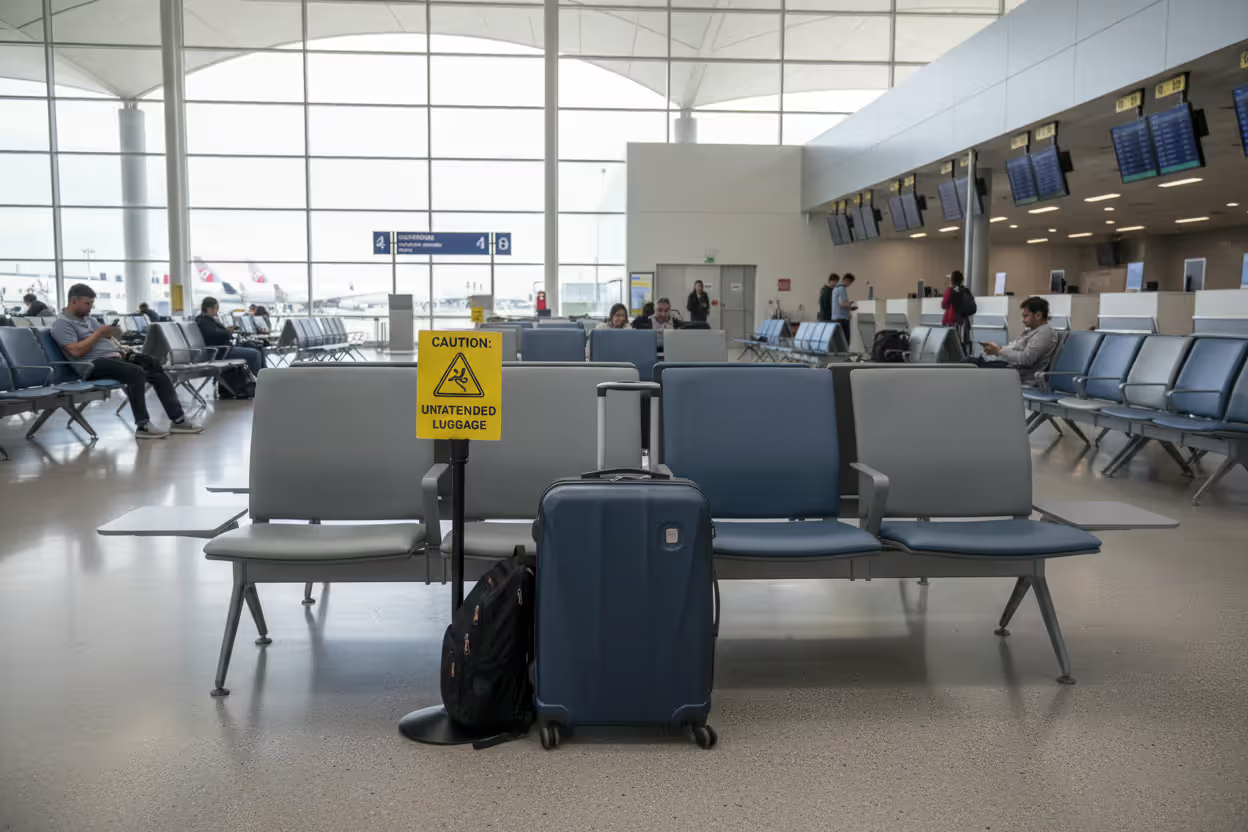
Unattended bags top the list of denied claims. Left your suitcase by the check-in kiosk while you ran to the restroom? Set it down at an airport restaurant while you grabbed food? Walked away from your luggage in the hotel lobby? Insurers expect you to maintain control of your belongings, and abandoning them—even briefly—voids coverage. "I only left it for two minutes" won't save your claim.
Valuables in checked baggage represent another massive exclusion. Nearly every policy explicitly states that jewelry, cash, laptops, cameras, tablets, and similar high-value items belong in carry-on bags under your direct control. Check a bag containing your $1,500 camera and the airline loses it? Your travel insurance lost baggage coverage probably won't pay. Why? You violated basic security protocol by checking items you should have kept with you.
Pre-existing damage won't pass muster. That suitcase with the wonky wheel before your trip can't suddenly become a "damaged luggage" claim when the wheel finally breaks during travel. Same goes for normal wear and tear—scuffed corners, faded fabric, scratches that accumulated over years of use. The damage must be substantial, obvious, and clearly connected to this specific trip's handling.
Mysterious disappearance without documentation almost never succeeds. You arrive home, unpack, and realize your expensive headphones are missing from your bag. Where'd they go? When? You have no idea, no proof the bag was opened, no incident report. That claim's getting denied. You need contemporaneous documentation—the airline report showing your bag arrived damaged or opened, police reports if theft occurred at a known time and place.
Business equipment usually requires separate coverage. Your personal laptop might qualify, but specialized tools, inventory samples, professional photography equipment for client work—these fall under business property exclusions in standard travel policies. Check whether your business insurance extends to travel, or buy a specific rider covering professional gear.
The airline-versus-insurance fault question doesn't matter like you'd think. Many travelers assume that if the airline obviously screwed up, travel insurance shouldn't apply its deductible or limits. Wrong. Your policy functions as secondary coverage regardless of who caused the loss, paying after airline compensation maxes out according to its own terms. The carrier's mistake doesn't magically waive your deductible or boost your coverage limits.
How to File a Lost Luggage Claim With Your Insurer
Claim success starts at the airport, not when you get home and realize you're in trouble.
Before you leave baggage claim, hunt down an airline representative and file a Property Irregularity Report (PIR). This document—with its reference number, bag description, and official acknowledgment from the carrier—becomes the foundation of your entire claim. Skip this step, walk out of the airport without reporting the problem, and your insurance claim will die regardless of what other proof you gather later.

Author: Samantha Lowell;
Source: visitmuseumcampussouth.com
For delayed bags, every receipt matters. Bought a $15 toothbrush? Save that receipt. Grabbed a $40 shirt at the hotel gift shop? Keep it. Picked up a $12 bottle of shampoo? Hang onto the proof. Most policies demand itemized evidence of emergency purchases, and credit card statements alone typically don't satisfy the requirement (they're not detailed enough). Photograph receipts with your phone immediately—thermal paper fades within weeks, leaving you with blank slips when you file weeks later.
Documenting your lost items before problems arise transforms claims from guesswork to evidence. Photograph the contents of your suitcase before packing (sounds paranoid, actually works). Keep receipts for recent purchases. Maintain a written packing list with item descriptions and approximate values. When your bag disappears and the insurer asks what was in it, you can show them instead of estimating from memory. The difference in payout can hit hundreds or thousands of dollars.
Submit your claim within the policy's deadline—typically 20 to 90 days from when the loss occurred. Miss that window and you've forfeited coverage completely, even for legitimate losses. Don't wait for the airline to finish investigating. File with your insurer while the carrier continues searching, then update the claim if your bags appear. The two processes run parallel, not sequential.
Managing both airline and insurance claims simultaneously creates hassle but maximizes compensation. The airline's liability pays first, up to their legal limits. Lost luggage travel insurance then covers the gap between airline compensation and your actual losses, up to policy maximums. Track these separately in your records—which expenses you're claiming from whom—because submitting the same items to both creates coordination problems.
Brace yourself for a slow process—think weeks or months, not days. Claims require coordination between you, the airline, and the insurer, plus investigation time and verification. Check in regularly, respond to documentation requests immediately, and keep organized records of every email, call, and submission. Quick resolutions are rare. Persistence pays off, but patience is mandatory.
Travel Insurance vs Airline Compensation for Lost Bags
Airlines don't pay unlimited amounts when they lose your stuff—federal regulations cap their liability at specific amounts.
The Department of Transportation requires U.S. carriers to compensate up to approximately $3,800 per passenger for lost, damaged, or delayed bags on domestic flights (as of 2026). International flights fall under the Montreal Convention, which limits airline liability to about 1,288 Special Drawing Rights—roughly $1,700 to $1,900 depending on current exchange rates.
These limits sound reasonable until you actually calculate what you pack. One week-long trip might include $2,200 in clothing, $1,400 in electronics, $700 in toiletries and medications, plus $600 for the luggage itself—you're at $4,900. The domestic airline limit covers most of this, but that international limit leaves a $3,000 gap. Lost baggage coverage in travel insurance exists specifically to fill these gaps.
| Payment Source | Domestic Maximum | International Maximum | Delay Coverage | Depreciation | Filing Window |
| Airline liability | ~$3,800 per person | ~$1,700–$1,900 per person | Yes, limited amounts | Generally no | Report within 24 hours, file within 45 days |
| Travel insurance | Policy-dependent ($500–$5,000+) | Same limits as domestic | Yes, with daily caps and waiting periods | Yes, actual cash value | Generally 20–90 days |
Airlines rarely advertise their maximum liability upfront. They'll make lowball initial offers, hoping you don't know the regulations and will accept $600 for a $2,400 loss. Push back with documentation, cite the specific DOT or Montreal Convention limits, and escalate through supervisors if you hit resistance. Only after extracting maximum airline compensation should you turn to travel insurance for whatever remains.
Coordination of benefits clauses prevent collecting twice for identical losses. If the airline pays $1,400 and your actual loss totals $2,800, you can claim $1,400 from insurance (assuming your policy allows it). You cannot claim the full $2,800 from insurance and walk away with $4,200 total. The insurance adjusts your claim downward by whatever the airline already paid.
Credit cards add a third coverage layer. Premium travel cards often include baggage delay and loss protection as cardholder perks, typically maxing out around $3,000. This coverage usually requires that you purchased tickets with that specific card. It coordinates with both airline liability and standalone travel insurance, paying after those sources but potentially filling remaining gaps at no additional cost.
Most travelers drastically underestimate their baggage value until they actually lose it. The real benefit of travel insurance isn't just higher limits than airline liability—it's coverage for scenarios where airlines aren't liable at all, like theft outside their custody or mysterious disappearance during connections
— Sarah Mitchell
Choosing Travel Insurance for Lost Baggage Coverage
Shopping for policies requires looking past the headline coverage number marketed on the front page.
A plan screaming "$3,000 baggage coverage!" in banner ads means little if you dig deeper and find $200 per-item caps with aggressive depreciation. Read the actual policy terms—not the marketing materials—for per-item limits, depreciation schedules, excluded item categories, and sub-limits before purchasing.
How much coverage makes sense depends on what you actually pack. Weekend domestic trip with carry-on only? Minimal baggage coverage suffices. Three-week international vacation checking two bags containing $6,000 in belongings? You need comprehensive protection approaching that value. Audit a typical packing list, calculate realistic replacement costs (not wishful thinking), and buy coverage that matches reality.
Riders for high-value items transform coverage for specific travelers. Photographers hauling $12,000 in camera bodies and lenses, jewelry enthusiasts traveling with family heirlooms, business travelers carrying specialized equipment—these people need scheduled coverage. Pay extra premium upfront, list specific items with values, and you remove per-item caps while sometimes waiving depreciation. The additional cost pays for itself the first time you file a claim.
Credit card travel insurance works adequately for straightforward trips but rarely matches standalone policy comprehensiveness. Card benefits typically cover basic scenarios—straightforward delayed or permanently lost luggage—while excluding situations like theft outside airline custody, damage to specific categories, or coverage above modest limits. Pull out your card's actual coverage certificate (not the marketing summary) and read what's really included before assuming you're protected.
Compare deductibles carefully across policies. A $50 deductible versus $250 makes substantial difference, particularly for delayed baggage claims involving modest emergency purchases. Pay $150 for necessities during a delay, then lose $250 to the deductible? You actually lose money by having the coverage. Higher deductibles reduce premiums but increase what you pay out-of-pocket when filing.
Annual multi-trip policies beat single-trip plans for frequent travelers. Take four trips annually? Annual coverage typically costs less than buying four separate policies while providing consistent protection across all trips. No gaps between policies, no rebuying coverage repeatedly, streamlined documentation when you eventually need to file.

Author: Samantha Lowell;
Source: visitmuseumcampussouth.com
Frequently Asked Questions About Travel Insurance and Lost Luggage
Lost luggage coverage in travel insurance delivers real value when you understand how it operates and coordinate it properly with airline liability. But it works best as backup to smart packing practices, not as replacement for them.
The coverage makes most sense on international trips where airline compensation limits drop dramatically, creating large gaps between what carriers legally owe and what your belongings actually cost. On domestic flights with higher airline liability limits, the insurance value shrinks unless you're packing expensive items that exceed standard carrier compensation.
What the policies can't do is magically restore your belongings or reimburse you at 100% of replacement value. Per-item caps, depreciation schedules, documentation requirements, and excluded categories all reduce payouts below what most travelers initially expect. Understanding these limitations before problems arise prevents unpleasant surprises when filing claims.
Before your next departure, review existing coverage through credit cards and other sources, calculate realistic replacement values for what you typically pack, and decide whether additional lost luggage travel insurance makes financial sense. Consider your risk tolerance, trip cost, destination, and whether you're checking bags containing valuable items. For many travelers, the modest premium proves worthwhile the first time you're staring at an empty baggage carousel with no idea where your belongings went.
Related Stories
Read more

Read more




The content on this website is provided for general informational and educational purposes only. It is intended to offer guidance on travel insurance topics, including coverage options, premiums, deductibles, trip cancellation protection, travel medical insurance, baggage coverage, travel delays, emergency medical evacuation, and related travel protection matters. The information presented should not be considered legal, medical, financial, or professional insurance advice.
All articles and explanations published on this website are for informational purposes only. Travel insurance policies can vary between providers, and details such as coverage limits, exclusions, reimbursement conditions, waiting periods, eligibility requirements, and claim outcomes may differ depending on the insurer, policy type, destination, traveler age, health status, and trip details.
While we strive to keep the information accurate and up to date, this website makes no guarantees regarding the completeness or reliability of the content. Use of this website does not create a professional relationship. Visitors should review the official policy documents provided by insurance companies and consult with licensed insurance professionals or qualified advisors before making decisions about travel insurance coverage.