

Senior couple at an international airport reviewing travel insurance documents
Travel Medical Insurance for Seniors Guide

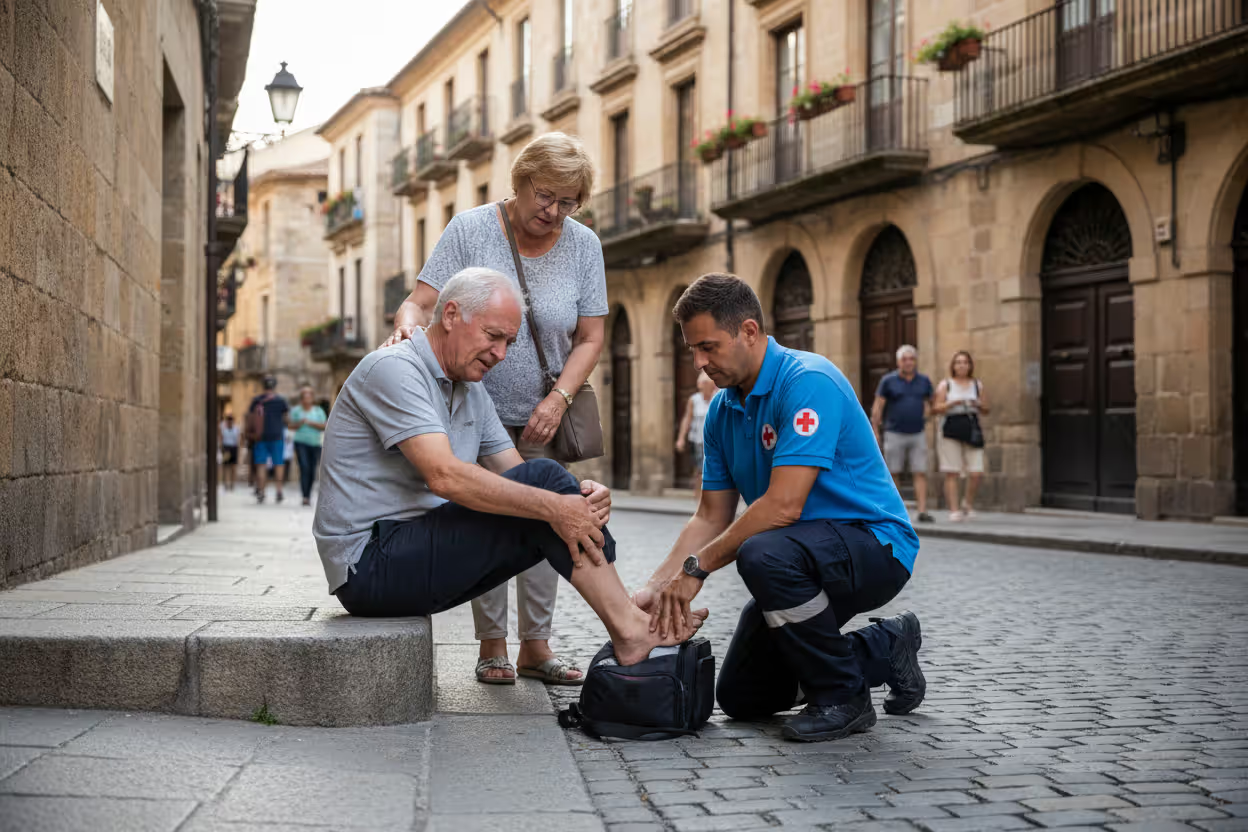
Your Medicare card becomes virtually useless the moment your plane touches down in Barcelona. That employer-sponsored health plan? It typically ends its responsibility at the U.S. border. This creates a dangerous coverage vacuum for older travelers—one that transforms routine medical problems into wallet-crushing disasters. Break your hip on a cobblestone street in Prague, experience cardiac trouble while snorkeling in Cozumel, or develop a serious bacterial infection during a Hawaiian vacation, and you could face hospital bills pushing past six figures. Your domestic insurer will probably deny the claim.
That's precisely why specialized medical coverage exists for traveling seniors. This isn't regular health insurance—it's purpose-built protection addressing the specific vulnerabilities older adults encounter when they venture beyond their home base, whether that means crossing into another country or simply visiting a U.S. state far from their usual doctors.
What Is Travel Medical Insurance and Why Seniors Need It
Think of this as temporary medical protection activated specifically during your time away from home. It covers emergency healthcare expenses that crop up on your trip. Regular health insurance operates year-round with comprehensive benefits; this functions more like a safety net designed exclusively for travelers during specific dates.
Here's what catches most people off guard: Medicare doesn't pay for medical care outside U.S. borders. Period. The exceptions are so narrow they barely qualify as exceptions—we're talking about situations where you're physically in the United States when an emergency strikes, but a Mexican or Canadian hospital happens to be closer than any American facility. Medicare Advantage plans sometimes include minimal overseas emergency benefits, but we're usually talking about coverage caps around $50,000 or below. That won't touch the cost of medical evacuation, which routinely hits $150,000 when you're flying from Southeast Asian countries or $75,000 from Caribbean islands.
What about regular health insurance with nationwide networks? Sure, it might technically cover you in all 50 states. But find yourself 2,000 miles from any in-network provider and you're paying out-of-network rates. Your deductible could triple overnight. Coinsurance percentages that were manageable at 20% suddenly balloon to 40% or higher.
Getting older changes the equation significantly. Statistics don't lie—seniors experience cardiovascular events, bone fractures from falls, flare-ups of existing conditions, and medication-related complications at higher rates when traveling. Unfamiliar surroundings, disrupted daily schedules, climate changes, and the physical toll of travel itself all pile on. Medical travel insurance for seniors is specifically structured around these age-related realities.
Author: Dylan Mercer;
Source: visitmuseumcampussouth.com
What Travel Medical Insurance for Seniors Covers
Here's what you'll typically find included in travel health insurance for seniors:
Emergency medical treatment: This covers everything from hospital admissions and doctor visits to diagnostic imaging, surgical procedures, and urgent care when sudden illness or injury strikes during your trip. You're generally looking at coverage ranging from $50,000 up to $500,000 per trip.
Medical evacuation: This pays for transport to the nearest facility equipped to handle your condition, or all the way back to the United States when local hospitals can't provide adequate care. This component alone justifies the insurance for many seniors—and it's the priciest to use. Just evacuating someone from a cruise ship can easily exceed $50,000.

Author: Dylan Mercer;
Source: visitmuseumcampussouth.com
Repatriation of remains: Should you die during your trip, the policy covers the cost of transporting your body home. Depending on the distance and logistics involved, this typically runs between $10,000 and $25,000.
Prescription medications: Emergency refills or replacements when medications are lost, usually with specific limits and requirements that you can document the original prescription.
Emergency dental care: Limited benefits for sudden dental pain or accident-related damage to teeth, generally capped somewhere between $500 and $1,000.
Standard exclusions you should know about: Pre-existing conditions represent the biggest gap unless you've purchased a special waiver (we'll cover that shortly). You also won't get coverage for routine checkups, elective surgeries, injuries from high-risk activities you didn't disclose when buying the policy, care related to substance abuse, or injuries from participating in professional-level sports.
Emergency medical travel insurance for seniors varies wildly in how different insurers define "emergency" and how aggressively they'll investigate pre-existing condition claims. Pay close attention to what actually triggers coverage and what documentation you'll need to submit.
How to Choose the Right Travel Medical Insurance Policy
Coverage Limits and Deductibles
Those bargain policies advertising $50,000 medical coverage? Inadequate for seniors heading overseas. A single week in a Swiss hospital can blow past $100,000. A serious illness requiring air ambulance evacuation plus extended hospitalization can reach $250,000 or beyond.
When shopping for international coverage, aim for medical benefits of at least $100,000 combined with evacuation coverage around $250,000. Heading to countries where healthcare costs run especially high—think Japan, Australia, Western Europe, Scandinavia—you should probably bump medical coverage to somewhere between $250,000 and $500,000.
Deductibles function somewhat differently here than what you're used to with regular health insurance. You'll choose between $0, $250, $500, or $1,000 per trip. Selecting a higher deductible shaves 15% to 30% off your premiums, but you're paying that entire amount out of pocket before any coverage kicks in. For seniors managing retirement income, $0 or $250 deductibles often prove worth the extra premium cost—you're essentially buying financial predictability.

Author: Dylan Mercer;
Source: visitmuseumcampussouth.com
Pre-Existing Condition Waivers
Standard policies exclude pre-existing conditions, defined as any illness, injury, or medical condition for which you consulted a doctor, took medication, or had symptoms during a "look-back period"—typically anywhere from 60 to 180 days before you purchased the policy.
For seniors managing ongoing health issues—high blood pressure, diabetes, cardiovascular disease, arthritis—this exclusion can essentially void the policy's value. Experience an atrial fibrillation episode in Barcelona and the insurer might deny your claim because you've been taking medication to manage the condition.
Pre-existing condition waivers eliminate these exclusions, but insurers attach strict conditions:
- You must purchase coverage within 7 to 21 days of making your initial trip deposit
- You need to insure the full trip cost (this requirement typically applies to comprehensive plans that bundle medical coverage)
- You must be medically cleared to travel when purchasing the policy
Not every international travel health insurance for seniors offers these waivers. Among those that do, coverage details vary considerably. Some policies cover acute onset scenarios—sudden, unexpected episodes—but not ongoing condition management. Others offer full coverage for stable conditions. Expect premiums to increase 20% to 40% for policies with strong pre-existing condition protection.
Trip Duration and Destination Requirements
Insurers price policies based on trip length. Travel medical coverage generally falls into these categories:
Single-trip policies: These cover one journey lasting up to 180 days. They make the most sense for seniors taking one or two significant trips each year.
Annual multi-trip policies: These cover unlimited trips within a year, with individual trip limits of 30, 45, or 60 days. They become cost-effective if you're traveling three or more times yearly, even for shorter trips.
Long-stay policies: These target snowbirds or extended international stays, providing 90 to 365 days of coverage.
Your destination dramatically affects pricing. Insurers calculate risk by region. A 70-year-old taking a two-week Canadian trip might pay $180, while identical trip length to Thailand runs $320, and a cruise visiting multiple countries could hit $450. These differences reflect healthcare costs, evacuation complexity, and risk factors specific to each location.
Some insurers won't cover certain countries at all or charge extra for destinations they consider high-risk—whether due to healthcare quality concerns, political instability, or disease outbreaks.

Author: Dylan Mercer;
Source: visitmuseumcampussouth.com
Cost Factors for Senior Travel Medical Insurance
Age dominates the pricing equation. Insurers segment premiums into brackets:
- 50-59: Baseline pricing
- 60-69: 40-60% premium increase
- 70-74: 80-120% premium increase
- 75-79: 150-200% premium increase
- 80+: 250-350% premium increase, with some carriers capping coverage at 85 or requiring medical questionnaires
Consider a 68-year-old taking a two-week European trip. That person might pay $220 for solid coverage including $100,000 medical benefits and $250,000 evacuation. The exact same policy for a 76-year-old runs $425. Reach 82 and you're looking at $650 or higher.
Additional pricing factors:
Trip length: Each week you add typically increases premiums 15% to 25%.
Coverage amounts: Doubling medical coverage from $100,000 to $200,000 usually adds 20% to 30% to your cost.
Destination risk: Countries with expensive healthcare systems and regions with limited medical infrastructure both push premiums higher.
Pre-existing condition coverage: This adds 25% to 50% to base premium costs.
Deductible selection: Choosing a $500 deductible over $0 can cut premiums by roughly 20%.
Realistic premium expectations for a 70-year-old on a two-week international trip: $280 to $550 for comprehensive coverage including evacuation. Budget policies with minimal coverage start around $150, but they're false economy—they fail precisely when you need them most.
Common Mistakes Seniors Make When Buying Travel Medical Insurance
Believing Medicare covers international travel: This misconception causes more claim denials than anything else. Medicare Part A and Part B provide exactly zero coverage outside U.S. borders except in extremely limited circumstances. Medicare Supplement plans (Medigap) offer some foreign emergency coverage, but there's a $50,000 lifetime cap and it only applies to the first 60 days of any trip.
Waiting until departure approaches: Buying medical travel insurance for seniors the day before your flight eliminates any chance of getting pre-existing condition waivers and sometimes triggers waiting periods. Several policies require purchase at least 24 to 72 hours before departure for coverage to activate.
Choosing inadequate coverage amounts: That bargain policy offering $25,000 medical coverage won't cover three days in a Tokyo ICU. Seniors need to consider worst-case scenarios: prolonged hospitalization combined with medical evacuation. That combination demands substantial coverage limits.
Misunderstanding primary versus secondary coverage: Secondary coverage only pays after your regular health insurance processes the claim first, creating administrative headaches and potential coverage gaps. Primary coverage pays immediately without requiring your regular insurance to act first, simplifying everything. For international travel where your regular insurance typically doesn't apply anyway, this distinction matters less, but for domestic trips, primary coverage justifies the 10% to 15% premium increase.
Skimming exclusions instead of reading carefully: That Costa Rican adventure tour might be excluded if it involves zip-lining or white-water rafting. Your cruise might lack coverage if the policy excludes specific countries on your itinerary. The policy might deny claims if you're traveling somewhere with State Department advisories.
Forgetting to bring documentation: Keep your policy number, the insurer's 24-hour emergency contact, and coverage details accessible—not buried in checked luggage. Photograph these documents and send copies to your email account.
Comparing Travel Medical Insurance Providers for Seniors
| Provider | Age Limit | Pre-Existing Coverage Type | Evacuation Coverage Maximum | Approximate Premium (70+, Two-Week International Trip) |
| GeoBlue Voyager | None | Acute onset episodes only | $500,000 | $380-$520 |
| IMG Patriot America Plus | 99 years | Waiver purchasable | $1,000,000 | $340-$480 |
| Seven Corners RoundTrip | 89 years | Acute onset episodes included | $250,000 | $290-$420 |
| Trawick Safe Travels | 89 years | Waiver purchasable | $500,000 | $310-$450 |
| HTH Worldwide TripProtector | None | Comprehensive with waiver | $500,000 | $420-$580 |
How Senior Travel Medical Insurance Differs from Trip Cancellation Insurance
These solve completely different problems, though insurers frequently bundle them together.
Travel medical insurance handles healthcare costs and emergency transportation while you're on your trip. Coverage begins after you leave home and specifically addresses medical emergencies occurring during travel.
Trip cancellation insurance reimburses money you've already paid for trip costs that you can't get refunded if you must cancel before leaving or end your trip early. Covered reasons usually include illness, injury, family member death, natural disasters, or airline failures. It's essentially financial protection for your trip investment.
People confuse these because comprehensive travel insurance packages combine both. You might pay $800 for a package providing $5,000 trip cancellation coverage, $100,000 medical coverage, and $250,000 evacuation coverage for a $7,000 cruise.
Seniors frequently need both types of protection. You face increased odds of pre-trip medical problems forcing cancellation, plus higher risk of medical issues during travel itself. Package deals make sense for expensive trips—generally those costing $3,000 or more per person. For cheaper trips, standalone travel medical insurance might suffice, particularly if your trip costs are refundable or you can absorb the financial loss.
Here's the core distinction: trip cancellation protects your finances before and during travel; medical coverage protects your health and finances during travel.
Premium estimates show ranges based on coverage amount differences, deductible selections, and specific destinations. Figures represent 2026 estimates and will vary based on individual circumstances.
I see the same critical error repeatedly among senior travelers: treating travel medical insurance as optional instead of essential trip planning. At 70 or 80, your body responds differently to stress, illness, and injury than it did at 50. A urinary tract infection that would be a minor annoyance at home can escalate into a serious medical crisis when you're dehydrated from a transcontinental flight and thousands of miles from your regular physician. Adequate coverage costs a fraction of the financial and health consequences you'll face without it
— Dr. Patricia Mendoza
Frequently Asked Questions About Travel Medical Insurance for Seniors
Senior travel medical insurance isn't paranoia—it's mathematics. Medical care needs increase statistically with age, the financial consequences of serious health events abroad can be catastrophic, and Medicare's coverage gaps are absolute. A $400 insurance premium seems expensive until you compare it to a $175,000 medical evacuation or a $90,000 foreign hospital bill.
The right policy balances adequate limits against affordable premiums, addresses your specific health situation, and matches how you actually travel. A couple taking three short trips annually needs different coverage than someone spending four months as a snowbird in Mexico.
Start by calculating your genuine risk exposure: your destinations, trip duration, existing health conditions, and what your current insurance actually covers versus what it excludes. Then compare policies on coverage limits, pre-existing condition treatment, evacuation coverage, and total cost. The cheapest option rarely delivers the best value, and the most expensive isn't always necessary.
Request quotes from at least three providers, read complete policy documents—not marketing summaries—and call each insurer's customer service with specific questions about your situation. How they handle your pre-purchase questions predicts how they'll handle your claims if you need them.
Travel should broaden your horizons, not threaten your retirement savings. The right travel medical insurance lets you focus on experiences rather than worrying about what happens if something goes wrong thousands of miles from home.
Related Stories

Read more

Read more




The content on this website is provided for general informational and educational purposes only. It is intended to offer guidance on travel insurance topics, including coverage options, premiums, deductibles, trip cancellation protection, travel medical insurance, baggage coverage, travel delays, emergency medical evacuation, and related travel protection matters. The information presented should not be considered legal, medical, financial, or professional insurance advice.
All articles and explanations published on this website are for informational purposes only. Travel insurance policies can vary between providers, and details such as coverage limits, exclusions, reimbursement conditions, waiting periods, eligibility requirements, and claim outcomes may differ depending on the insurer, policy type, destination, traveler age, health status, and trip details.
While we strive to keep the information accurate and up to date, this website makes no guarantees regarding the completeness or reliability of the content. Use of this website does not create a professional relationship. Visitors should review the official policy documents provided by insurance companies and consult with licensed insurance professionals or qualified advisors before making decisions about travel insurance coverage.