

Travelers at a cruise terminal with insurance documents before boarding
Travel Insurance for Cruise Trips Explained

Content
Content
Here's what nobody tells you when you book that dream cruise: you're handing over $4,000 to $15,000 for something that won't happen for another six months. Maybe eight. Your cruise line now holds that money, and three months before you sail, they're keeping it no matter what happens to you. Break your ankle? Keep the money. Lose your job? Keep the money. Hurricane coming? We'll try to reschedule, but we're definitely keeping your money.
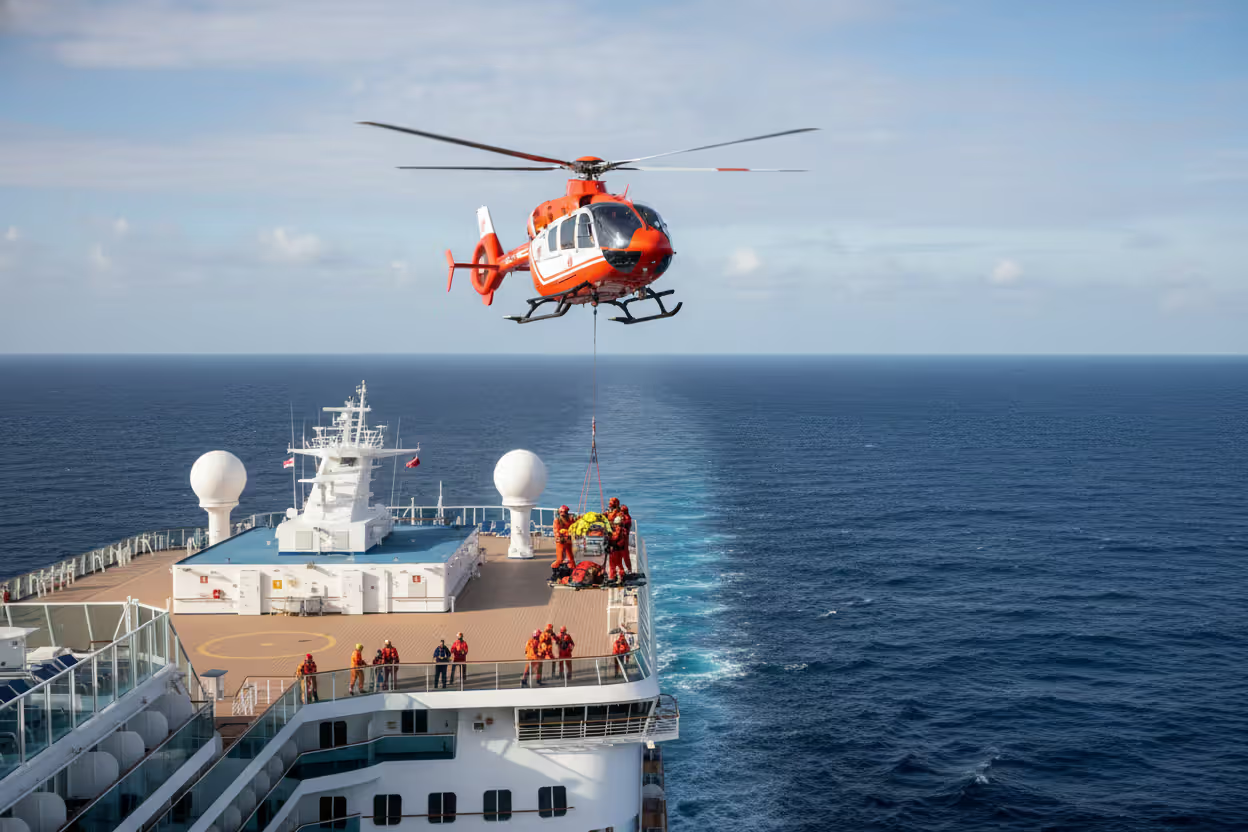
Then there's the medical situation. You get chest pain at 2 AM while your ship is 200 miles off Grand Cayman. The ship's doctor runs an EKG, monitors you overnight, and decides you need a real hospital. A helicopter lifts off from the ship's deck at sunrise. By the time you're in a Miami ICU, someone's preparing a bill for $63,000. Your regular insurance? Doesn't apply to ships. Medicare? Stops at the three-mile limit.
This explains why cruise insurance exists as its own category.
What Does Cruise Travel Insurance Cover?
Travel insurance for cruises splits into five main buckets, each addressing a specific way cruising can drain your bank account.
Trip cancellation coverage steps in when you can't board the ship. Your policy lists qualifying reasons—usually serious illness, family death, jury duty, house fire, that kind of thing. When these happen and the cruise line refuses your refund, insurance pays instead. Real example: a Denver couple paid $8,400 for an Alaska cruise. Six weeks out, the husband tore his ACL skiing. The cruise line offered a future credit minus $1,200 in fees. Their insurance cut a check for the full $8,400.
Medical expense coverage handles doctor visits and treatment while you're cruising. Ship doctors aren't covered by your regular health plan—they're running independent practices that happen to float. They charge accordingly. Basic sick call runs $200-$400. Sutures for a cut? $500. Fracture requiring X-rays and splinting? Easily $2,000. Shore-side hospitals in port cities add another layer of expense. One passenger needed emergency dental work in Cozumel: $3,200 out of pocket. Standard policies cover $50,000 to $100,000 in medical bills, though you'll want to match this to your itinerary.
Author: Samantha Lowell;
Source: visitmuseumcampussouth.com
Emergency evacuation coverage pays for the biggest ticket item in cruise insurance. Getting you off a ship in the middle of the ocean and into a proper hospital involves helicopters, Coast Guard coordination, sometimes air ambulances with full medical teams. A routine evacuation from a Caribbean cruise runs $25,000-$40,000. Remote locations multiply that fast. One evacuation from a repositioning cruise in the South Pacific: $127,000. Cruise lines arrange this. They don't pay for it.
Trip interruption protection covers getting you home when you have to leave the cruise early. Your mom has a stroke on day three of your Mediterranean cruise. You're in Barcelona. You need flights home to Phoenix, tonight. You're looking at $3,400 in same-day airfare, another $200 for the hotel you needed near the airport. The seven remaining cruise days? You already paid for those. Trip interruption coverage reimburses these costs—usually 100-150% of your trip cost to handle expensive last-minute travel.
Baggage coverage reimburses lost or stolen luggage, damaged items, and—crucially for cruises—delayed bags. When your luggage doesn't make your connection and the ship sails without it, this pays for clothes and toiletries at the first port. One couple cruising from Barcelona had bags delayed in Munich; their policy covered $600 in emergency purchases before their luggage caught up in Naples.
Do You Need Trip Insurance for a Cruise?
Three factors determine whether you should buy trip insurance for cruise travel: how much you're risking, your health variables, and where the ship's going.

Author: Samantha Lowell;
Source: visitmuseumcampussouth.com
Start with the money question. Add up everything you've prepaid: cruise fare, flights, hotels before and after, shore excursions you've booked. That's your exposure. Now check the cruise line's cancellation policy. Most cruise lines go to full penalties 60-90 days before sailing. Can you afford to lose that entire amount? A retired couple spending $15,000 on an anniversary cruise probably can't. A single traveler spending $1,800 on a quick Bahamas trip might absorb that hit.
Your health situation matters more at sea than on land. Age plays a role—travelers over 70 face higher medical incident rates. Chronic conditions increase risk even when well-controlled. Take insulin? Have a pacemaker? History of blood clots? These conditions don't prevent you from cruising, but they make medical coverage essential. One diabetic passenger had blood sugar issues in rough seas, couldn't keep food down, ended up needing IV fluids and monitoring in the medical center: $2,800 for two days of care.
Where you're sailing changes the calculation dramatically. Three-night Bahamas cruise? You're never far from Florida hospitals. Two-week transatlantic crossing? You'll spend days where helicopter range won't reach land. Antarctic expedition? You're looking at potential evacuations costing $200,000+ to reach South American medical facilities. Remote itineraries make high evacuation coverage non-negotiable.
Cruise-specific scenarios add layers regular travel doesn't face. Hurricanes force itinerary changes—ship skips Jamaica, goes to Grand Cayman instead. The cruise line owes you nothing; you got a cruise. Some policies reimburse missed ports you specifically wanted to visit. Engine failures occasionally cancel cruises entirely. The cruise line refunds your fare but not your non-refundable flights or prepaid hotels. Insurance covers those extras.
Weather delays that make you miss the ship's departure represent another cruise-specific risk. Your flight from Denver gets delayed by snow, lands three hours after the ship left Port Canaveral. Now you're buying last-minute flights to the next port, usually $800-$1,500, plus hotels. Miss-the-ship coverage handles this.
The biggest adventure you can take is to live the life of your dreams
— Oprah Winfrey
How Cruise Trip Insurance Differs from Standard Travel Insurance
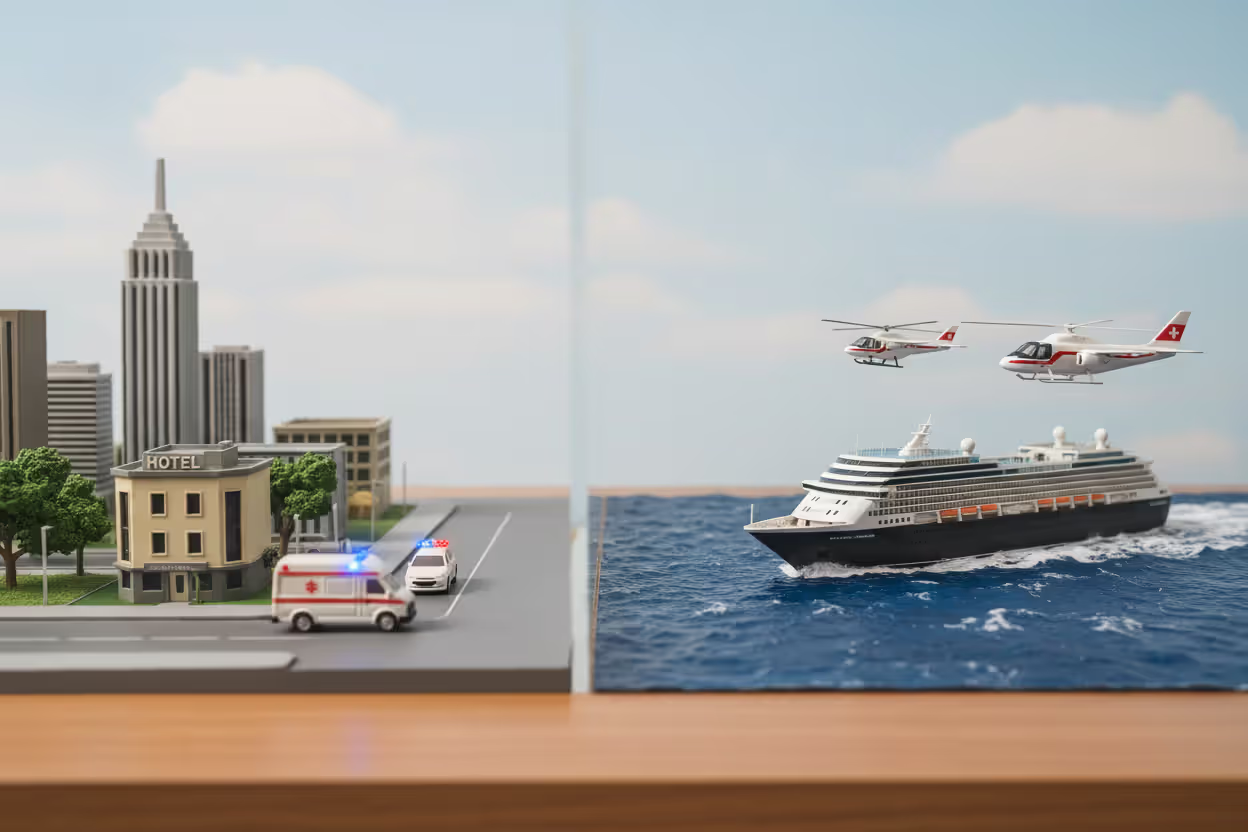
Regular travel insurance assumes you're sleeping on land near hospitals. Cruise trip insurance accounts for floating 300 miles offshore.
Evacuation coverage limits tell the story. Land-based policies might include $25,000 for emergency transport—enough for an ambulance to a hospital or even a short medical flight. Cruise policies should start at $100,000 because maritime evacuations cost that much. Coast Guard helicopters have 200-mile ranges. Beyond that, you're chartering private aircraft with medical capabilities. One family's evacuation from a Pacific cruise to Honolulu required a medically-equipped charter: $94,000. Travelers on Antarctic or remote Asian cruises often buy $250,000 limits.
Pre-existing condition waivers operate on different timelines for cruises. Insurers waive these exclusions when you buy coverage within 10-21 days of your initial deposit and insure the complete trip cost. This window matters more for cruises because you're booking so far ahead. Book a January cruise for September departure? Eight months for your blood pressure to act up, your knee to worsen, your atrial fibrillation to return. The waiver purchased in January covers these even though they happened before the cruise.
Supplier default protection—covering cruise line bankruptcy—appears in comprehensive cruise policies but not standard travel coverage. When a cruise line fails financially, your prepaid money disappears. Bankruptcy coverage reimburses your loss. This seemed theoretical until several smaller cruise lines collapsed in 2023-2024, stranding thousands of booked passengers. Those with bankruptcy coverage recovered their money. Those without lost everything.
Trip interruption limits need to be higher for cruise travel than hotel-based trips. Leaving a cruise early means booking last-minute international flights from wherever your ship happens to be. A passenger who needed to fly home from Athens to handle a family emergency paid $2,800 for next-day flights—standard $1,000 trip interruption limits fell short. Cruise policies often include 150% of trip cost for interruption versus 100% for cancellation.
Author: Samantha Lowell;
Source: visitmuseumcampussouth.com
What Cruise Lines Don't Cover
Cruise lines make clear they're not responsible for medical costs, evacuations, or your expenses when things go wrong.
The medical center on your ship operates independently. Think of it as a private clinic that happens to be on a boat. The doctors and nurses aren't cruise line employees in most cases—they're contractors running their own practice. You pay for every service. One passenger treated for suspected heart attack received separate bills: $1,200 for doctor consultations, $3,400 for medications and monitoring, $8,900 for two nights in the medical center. These charges appeared on his cabin account before the ship docked.
Evacuation costs fall entirely on passengers. The ship's doctor decides you need evacuation. The cruise line's medical coordinator arranges the helicopter, contacts the receiving hospital, handles logistics. They're excellent at coordination. They just don't pay. You authorize the charges, which can reach six figures, before the evacuation proceeds. They'll help you contact your insurance company, but you're guaranteeing payment.
When you need to leave a cruise early, you're handling your own travel. Family emergency requires you to fly home from Rome three days into a Mediterranean cruise? You're booking flights, paying for them, and forfeiting the unused cruise days. Cruise lines don't refund partial sailings except in rare cases like ship mechanical failure forcing cancellation.
Miss the ship at embarkation because your flight was delayed? The ship sails on schedule. Cruise lines don't hold departures for late passengers or pay to transport you to the next port. You can try to catch up at your own expense or consider the cruise lost. One couple missed their Barcelona departure due to a delayed flight from London—spent $1,400 on same-day flights to catch the ship in Palma de Mallorca the next day.

Author: Samantha Lowell;
Source: visitmuseumcampussouth.com
How to Choose Travel Insurance for Cruises
Matching coverage to your specific cruise requires looking at destination, duration, your health, and what could go wrong.
Where you're cruising determines medical coverage needs. Caribbean and Mexican Riviera cruises keep you near North American facilities, making $50,000-$75,000 medical coverage reasonable. You're never more than a few hours from Miami, Houston, or San Diego hospitals. Mediterranean cruises justify $75,000-$100,000 since European hospital costs vary widely—treatment in Greece costs less than France. Transatlantic crossings, South Pacific itineraries, or expedition cruises to remote regions demand $100,000+ medical coverage minimum and $150,000-$250,000 evacuation limits. You'll spend days beyond helicopter range of advanced medical care.
Cruise duration affects your cancellation coverage calculation. That four-day Bahamas cruise costing $1,400 needs less coverage than a 21-day Panama Canal cruise at $11,000. Make sure your policy's trip cost limit exceeds your total prepaid expenses—not just the cruise fare. Add flights, hotels, shore excursions, even pet boarding costs. One couple underinsured by only covering their $7,500 cruise fare, forgetting they'd also prepaid $2,100 in flights and $900 in booked excursions. Their policy maxed out at $7,500.
Pre-existing conditions require strategic timing. Any ongoing health issue needs attention here: diabetes, heart conditions, cancer history, controlled hypertension, previous surgeries with ongoing monitoring. Purchase insurance within your provider's window—usually 10-21 days after your first trip payment—to activate the pre-existing condition waiver. Miss this deadline and the policy excludes anything related to those conditions. One traveler with controlled diabetes bought insurance 35 days after booking; when blood sugar issues forced cancellation, the claim was denied as pre-existing.
Cancel-for-any-reason coverage costs 40-60% more but removes the "covered reasons" requirement. Standard policies only reimburse for specific situations—illness, family death, jury duty. CFAR lets you cancel because you changed your mind, work got complicated, you don't feel like going, whatever. The catch: it typically reimburses 50-75% of costs rather than 100%, and you must purchase it within 10-21 days of initial booking. Makes sense for expensive cruises booked far in advance where circumstances might change.
Shore excursions involving adventure activities need specific coverage. Standard policies exclude what insurers call "risky" activities. Scuba diving below 60 feet, zip-lining, ATV tours, helicopter excursions, even horseback riding sometimes get excluded. Planning to dive the Great Blue Hole in Belize or zip-line through Alaskan rainforests? Check your policy's activity list. You might need adventure sports coverage added on. One passenger injured during a zip-line excursion in Honduras discovered his policy specifically excluded zip-lining—$6,800 in medical bills paid out of pocket.
Financial stability of your cruise line factors into whether you need bankruptcy protection. Major cruise lines with decades of operation—your Carnivals, Royal Caribbeans—present minimal bankruptcy risk. Newer lines, especially luxury or expedition operators, carry higher risk. Comprehensive policies with supplier default coverage protect against this. After one small luxury cruise line failed in 2024, passengers with bankruptcy coverage recovered their $8,000-$20,000 cruise payments. Those without lost everything.
Common Exclusions in Cruise Travel Insurance
Even thorough cruise policies contain exclusions that surprise travelers who don't read the fine print.
Running late doesn't count as missing the ship. Insurance covers missed departures from specific events—flight delays, documented traffic accidents, emergencies. Just arriving late because you misjudged drive time or overslept? That's on you. One couple missed their Miami departure because they "didn't expect traffic to be that bad" on I-95. Insurance denied their claim to catch up; they ate the entire $5,200 cruise cost.
Alcohol voids most coverage. Get injured while intoxicated and your claim gets denied. Falls, excursion injuries, even medical emergencies where alcohol was a contributing factor—policies exclude these. The language usually says "claims arising from or related to alcohol use." One passenger fell on deck after drinking at the bar, needed medical treatment for a fractured wrist. His claim was denied after the ship's doctor noted alcohol consumption in medical records.
Adventure activities face blanket exclusions in basic policies. Racing anything, parasailing, skydiving, cave diving, bungee jumping—these require special coverage or appear in the excluded activities list. Less extreme activities get excluded too. Jet skiing, rock climbing, even snorkeling in some policies needs checking. Always review the policy's excluded activities section before booking shore excursions.
Finding a better deal isn't a covered cancellation reason. Standard cancellation covers illness, injury, family death, jury duty, home disasters. Not: changed your mind, found a cheaper cruise, work schedule shifted, decided you don't want to go. Those require CFAR coverage. One traveler booked an Alaska cruise, then found the same itinerary $2,000 cheaper six weeks later. His standard policy wouldn't let him cancel to rebook the better deal.
Health conditions you knew about before buying insurance remain excluded unless you meet the waiver requirements. The timeline matters. You have chronic back problems. You book a cruise. Thirty days later you buy insurance. Before the cruise, your back flares up and you can't go. Standard policy excludes this—your back condition existed before the policy. Had you purchased within 10-21 days of initial booking, the waiver would have covered it.
Pandemic and epidemic coverage varies by timing and insurer. Once an outbreak becomes publicly known—declared by WHO or CDC—new policies typically exclude claims related to it. Some insurers now offer pandemic coverage as add-ons, others build it into comprehensive plans, many exclude it entirely. After COVID, this became a critical question to ask explicitly when shopping for coverage.

Author: Samantha Lowell;
Source: visitmuseumcampussouth.com
Cost of Trip Insurance for Cruises
Expect to pay 4-10% of your total prepaid trip costs, with the percentage climbing based on age, destination, and coverage type.
A 45-year-old couple spending $6,000 on a Caribbean cruise typically pays $240-$360 for basic coverage including standard medical limits and trip cancellation. Same couple at age 72? Now they're looking at $420-$600 because insurers price for increased medical risk. Age 75+ sees another jump—sometimes double the rates of travelers under 60.
Comprehensive policies with enhanced limits—$100,000+ medical, $250,000 evacuation, increased baggage protection—add 30-50% to base premiums. That $6,000 Caribbean cruise might cost $320-$450 to insure comprehensively, or $500-$750 for travelers over 70.
Adding cancel-for-any-reason coverage increases premiums by 40-60%. If your standard policy costs $300, CFAR brings it to $420-$480. Whether that's worth it depends on your situation. For a $12,000 cruise booked nine months out with uncertain work schedules, maybe. For a $2,500 cruise booked six weeks ahead with stable circumstances, probably not.
Several variables push your premium up or down:
Trip cost forms the foundation—you're insuring that dollar amount. A $3,500 cruise costs less to cover than a $14,000 cruise, all else equal.
Your age impacts pricing dramatically. Insurers see significant jumps at 60, 70, and 75. An 80-year-old might pay 2-3 times what a 50-year-old pays for identical coverage because medical claims increase substantially with age.
Sailing destination matters because medical costs and evacuation complexity vary by region. Cruises to remote areas (Antarctica, South Pacific) or expensive medical regions (Alaska, Northern Europe) cost more to insure than Caribbean cruises where evacuation is simpler and medical care closer.
Length of the cruise affects pricing because more days means more opportunity for something to go wrong. A 14-day cruise costs more to insure than a four-day cruise of equivalent total price.
Purchase timing determines which options you can access. Buy within 10-21 days of your initial cruise deposit and you unlock pre-existing condition waivers and CFAR eligibility. Wait until a month before sailing and you'll get basic coverage but lose those enhanced options.
Shopping strategies: Get quotes from at least three insurers, buy soon after making your cruise deposit to maximize options, and match coverage levels to actual risk rather than buying the most expensive policy or under-insuring to save money.
Frequently Asked Questions About Cruise Travel Insurance
Cruises concentrate financial risk differently than land vacations. You prepay everything months ahead, you'll be far from familiar hospitals, and flying home when problems arise isn't simple. The right insurance converts unpredictable catastrophic costs into fixed, manageable premiums.
The math is straightforward. Calculate what you'd lose if you couldn't sail, add realistic medical and evacuation costs for your destination, compare that total to insurance premiums. For most people, spending $350 to protect a $6,000 cruise makes sense. For some situations, self-insuring works better.
Three coverage types are non-negotiable: trip cancellation matching your complete prepaid costs (cruise, flights, hotels, excursions), medical coverage appropriate to where you're sailing ($50,000 minimum, $100,000+ for remote regions), and evacuation coverage of at least $100,000. Everything beyond that—CFAR, enhanced baggage limits, missed port coverage—depends on your circumstances and risk tolerance.
Buy within that initial 10-21 day window after booking to maximize your options. Read the exclusions section carefully so you understand what won't be covered. Keep policy documents accessible during your cruise—hotel safe, phone photos, email copies.
The goal isn't buying the most expensive policy available or the most comprehensive coverage. It's purchasing protection against specific financial risks your particular cruise presents.
Related Stories

Read more

Read more




The content on this website is provided for general informational and educational purposes only. It is intended to offer guidance on travel insurance topics, including coverage options, premiums, deductibles, trip cancellation protection, travel medical insurance, baggage coverage, travel delays, emergency medical evacuation, and related travel protection matters. The information presented should not be considered legal, medical, financial, or professional insurance advice.
All articles and explanations published on this website are for informational purposes only. Travel insurance policies can vary between providers, and details such as coverage limits, exclusions, reimbursement conditions, waiting periods, eligibility requirements, and claim outcomes may differ depending on the insurer, policy type, destination, traveler age, health status, and trip details.
While we strive to keep the information accurate and up to date, this website makes no guarantees regarding the completeness or reliability of the content. Use of this website does not create a professional relationship. Visitors should review the official policy documents provided by insurance companies and consult with licensed insurance professionals or qualified advisors before making decisions about travel insurance coverage.